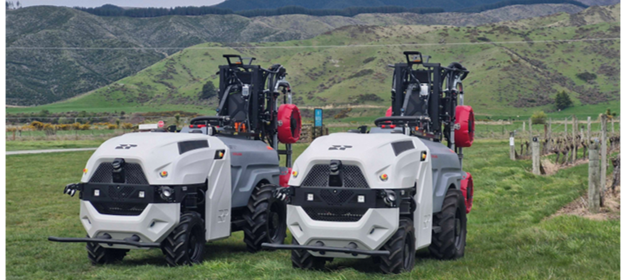
The integration of Prospr has significantly increased operational efficiency at River Terrace by automating spray cycles, leading to substantial reductions in both input costs and labour expenses. Inspiring expansion of Prospr operations into an adjacent vineyard to optimise usage over a full 10-day spray cycle.
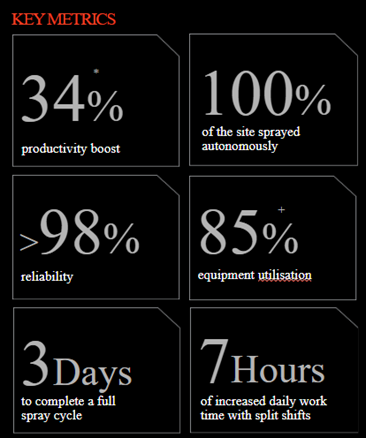
* This productivity boost is calculated based on an increase in time spent in row, with a rise from 1Ha/hr (2.4 ac/hr) to 1.3Ha/hr (3.2 ac/hr). + This figure represents the percentage of time the equipment is actively operational in row over the course of the day.
Key Details
Pain Points:
- Availability of reliable labour, crucial for time-sensitive and seasonal viticultural tasks
- Requirement for improved productivity to remain competitive
- Rising input and labour costs which affect financial stability and profit margins
- Complying with growing sustainability demands and meeting organisational targets for net zero emissions by 2030.
- Complex site topography and navigational risk during implementation.
Solutions:
- Successful implementation of two Prospr vehicles, increasing operational efficiency and productivity
- Transformed existing sprayer into a nurse cart, optimising resources and maximising the time Prospr spends in row.
- Implemented a single centrally located mast for full site coverage, complemented by a secondary roaming radio on an operator vehicle for tablet UI access in the field.
Results
Productivity Enhancement
- Increased hourly work rate by 34% to 3.2 ac/hr (1.3 Ha/hr).
- Machines can cover 300 Ha (740 ac) in eight 15-hour days, with a 2-day weather buffer.
Effective Implementation
- Workrate and reliability targets met by round 4 (1.3Ha/hr and >98% uptime).
- 100% of site sprayed autonomously by sixth spraying round
Financial Benefit
- $132K operational savings annually, including $16k NZD repair and maintenance cost reduction.
Operational Efficiency
- Reassigned sprayer as nurse cart to complement Prospr.
- Increased daily operational hours from 8 to 15 hours (+7hrs), despite reduced labour requirements.
Efficient Staff Upskilling
- New operator trained to confidently operate two machines and a nurse cart in under 3 days.
- User-friendly interface for easy operation.
Sustainability
- Enhanced fuel efficiency – 70% reduction in fuel consumption and a hybrid diesel-electric engine which lowers emissions.
- Strengthened TWE focus on automation to address labour challenges.
Outcomes vs Traditional Methods
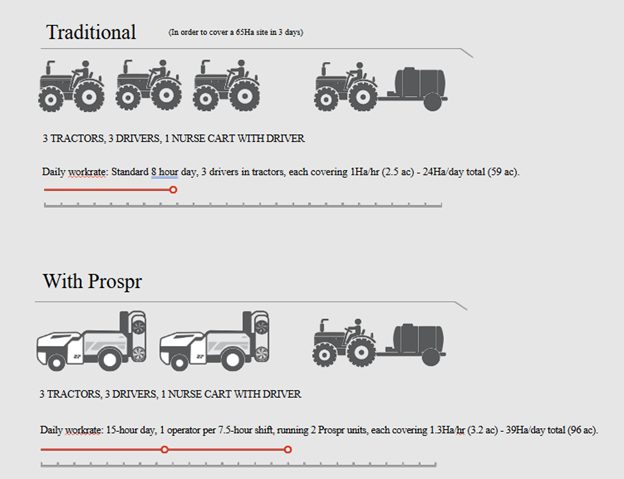
Return on Investment
Based off the implementation of two Prospr vehicles, on a 65Ha vineyard, with a 3-day spray window.
Payback Period: 3.3 years
10-Year ROI: 57%
^Payback is based on the investment over and above the cost of new tractor and sprayer.
- Hourly operational savings
- Maintenance savings: $7 NZD/hr
- Consumables & Fuel Saving: $34 NZD/hr
- Labour saving: $170 NZD/hr
- Annual operational savings
- Total (after subscription): $115k NZD
- Maintenance Savings: $4k NZD
- Consumables & Fuel Savings: $21k NZD
- Labour Savings: $102k NZD
The Opportunity for Further Improvement
With two Prospr vehicles, it’s possible to cover 300 hectares in just eight 15-hour days. This approach would result in a payback within a single season, over and above the traditional manual tractor and sprayer setup. Alternatively, it would take only 1.5 seasons to achieve payback outright. Giving the potential to accelerate payback by utilising existing fleet over a larger site, so it is productive for a full spray window.